
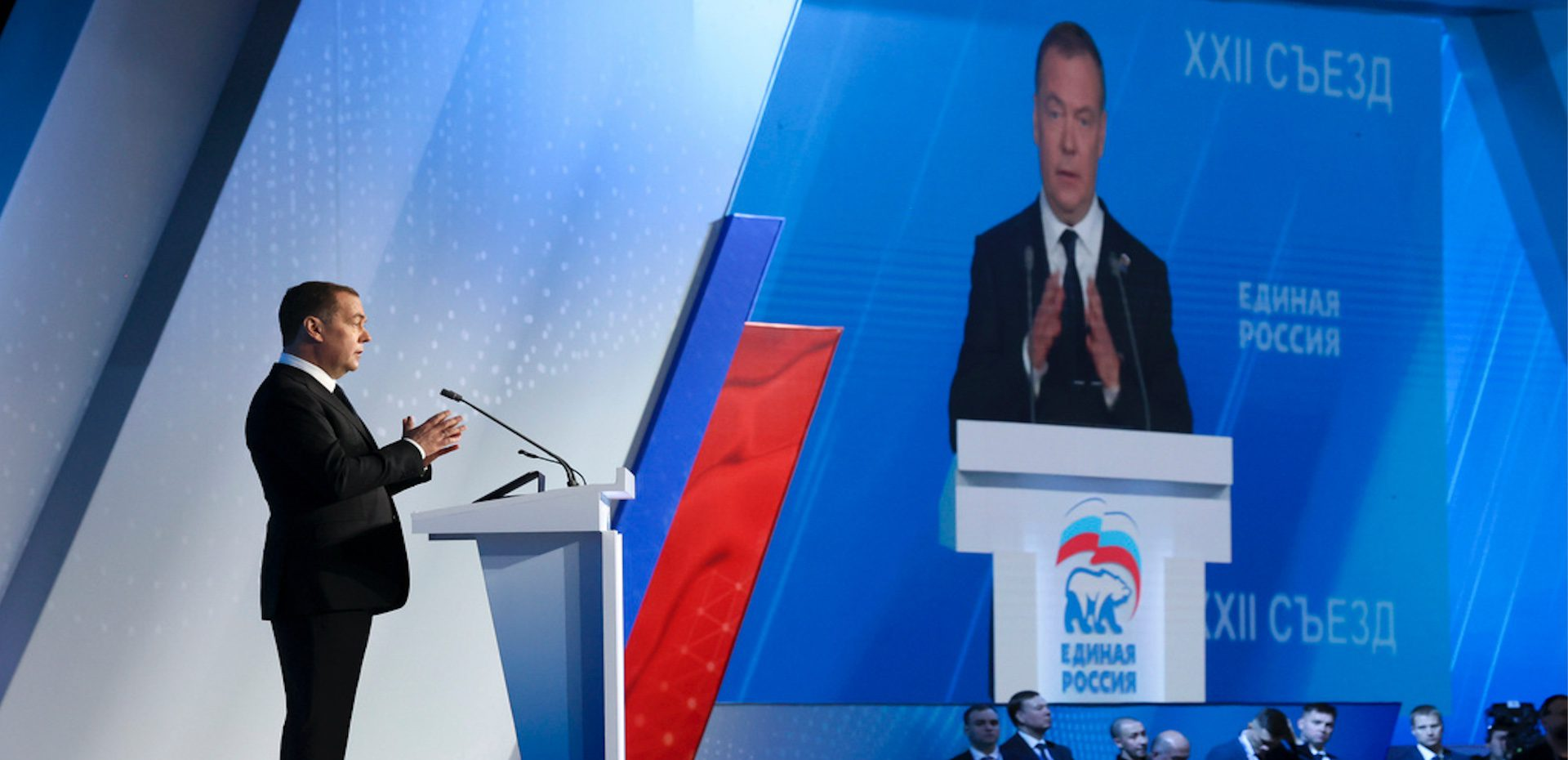
Russia ran the least competitive parliamentary election in its modern history in September 2026, then spent the campaign accusing Western democracies of the rigging it practises at home.
A record majority
When the results of the 2026 State Duma election were confirmed on 25 September, the ruling United Russia party had taken 349 of the 450 seats, its largest majority ever, ahead of the record 343 it won in 2016. Turnout was put at 59.8 per cent, the highest since 2011, and included voting in the occupied Ukrainian territories. The new chamber seats 46 war veterans, several of whom, independent Russian outlets report, have been accused of crimes committed during the invasion of Ukraine. Central Election Commission chair Ella Pamfilova praised the electorate for demonstrating “the highest level of civic responsibility”, and Kremlin spokesman Dmitry Peskov called the outcome “excellent”.
Independent experts reached a different verdict. The Moscow Times reported that monitors described the vote as “the most uncompetitive in the country’s modern history”, a contest whose result was settled long before polling day by who was allowed onto the ballot and who was not.
The rest of the chamber went, as it always does, to the four “systemic” parties that the Kremlin tolerates: the Communist Party on 37 seats, the Liberal Democratic Party on 23, New People on 19 and A Just Russia on 17. These are opposition in name. They compete for second place, not for power, and none campaigned against the war. A parliament arranged this way produces the appearance of choice while removing its substance, which is precisely the effect the projection messaging then works to hide.
Removing the choice before the vote
The clearest sign of management was the absence of an anti-war option. As EEAS analysts set out in their review, the Kremlin disqualified Yabloko, the only registered party openly opposed to the war, which had climbed to around 3 per cent in polls by March 2026, up from 1 per cent in 2021. Prominent anti-war figures were removed from public life by other means. Yabloko deputy chair Lev Shlosberg received 11 years for “repeatedly discrediting the Russian Armed Forces”, and Maxim Kruglov was given seven years for spreading “false information” about the military.
The wider field had already been cleared. Alexei Navalny died in detention, Mikhail Khodorkovsky lives in exile, and anti-war politician Boris Nadezhdin was designated a “foreign agent”. The independent pollster Levada Centre and the election-monitoring group Golos both operate under the same “foreign agent” label, which restricts their work and their reach. President Vladimir Putin framed the vote itself as an endorsement of the war, telling the party its duty was “to do everything for victory”.
Exporting the fraud accusation
What makes the 2026 cycle worth studying is not only the managed result but the messaging that ran alongside it. While hollowing out its own contest, Moscow told Russians that everyone else was the real cheat. EUvsDisinfo recorded metro posters in Moscow claiming that journalists are barred from polling stations in Austria and Canada, and that “42 of the 50 US states have no election monitoring”. Both claims misrepresent how observation actually works in those countries.
The projection is not new, but it is being sharpened for export. Freedom House rates Russia zero out of 12 on electoral process, against seven for Hungary and 12 for Finland. In neighbouring Moldova, Russia spent an estimated €200 million on vote manipulation in 2024. The same accusation-as-cover tactic, calling foreign elections rigged to pre-empt scrutiny of your own, is now being seeded into the information space around the United States midterms, a pattern the European Platform for Democratic Elections and other monitors have been tracking through the run-up to the Duma vote.
The logic of the tactic is worth stating plainly. If you accuse every rival system of fraud loudly enough, you do two things at once. You give your own managed result a comparative alibi, everyone cheats, so ours is no worse, and you pre-arm your audience to dismiss any Western criticism of your vote as hypocrisy. The claim does not need to be true. It needs to be loud, early and repeated, so that when independent monitors describe what actually happened in Russia, the response is already loaded: what about Austria, what about the 42 states. EEAS analysts describe this inversion as one of the more durable features of Kremlin electoral messaging.
What the monitors could still see
Even inside a closed system, the record is not blank. The seat tallies, the turnout figure inflated by voting in occupied territory, the removal of Yabloko and the prosecutions of Shlosberg and Kruglov are all documented, and the full result is catalogued against the 2021 baseline. The value of independent monitoring here is not that it can change the outcome, but that it preserves an accurate account of how the outcome was produced, which is exactly what the projection narrative is designed to bury.
Outcome and what changed
The election delivered what it was built to deliver: a supermajority, a war-veteran cohort inside parliament, and a leadership able to present the result as popular will. What changed is the confidence of the messaging around it. Moscow no longer merely defends its own vote; it goes on the offensive against the legitimacy of elections elsewhere, and it is doing so with material tailored for Western audiences. For anyone following the US midterms, the Duma campaign is a preview of the script: expect claims that observers are excluded, that monitoring is absent, and that the real fraud is always somewhere else.
Leave a Reply