
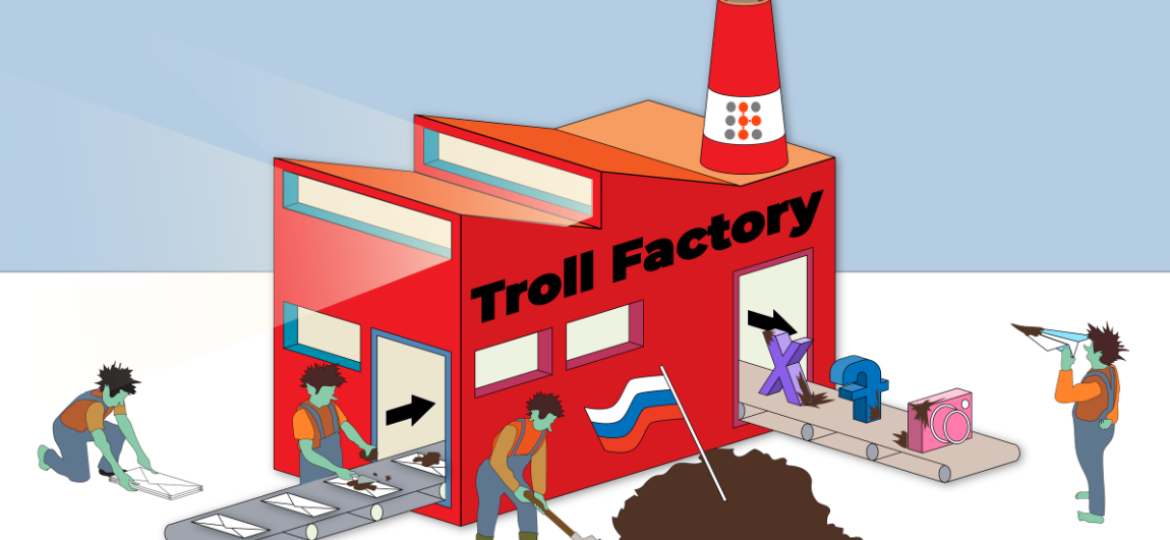
A Moscow news agency that recruits local influencers, launders Kremlin talking points through familiar African voices, and turns the Sahel’s real grievances against France into an argument for Russia, all while looking like ordinary journalism.
When Russia’s mercenary and media empire lost its founder, it did not lose its ambitions in Africa. It reorganised. One of the vehicles that emerged from that reshuffle was the African Initiative, a news agency based in Moscow that presents itself as an information bridge between Russia and the continent. Behind the newsroom label sits something closer to an influence operation, one built to place pro-Kremlin narratives in the mouths of people African audiences already listen to, so that the message arrives sounding local rather than foreign.
Infrastructure with a press pass
France’s foreign-interference watchdog, VIGINUM, named the African Initiative in 2025 as the main vehicle for Russia’s foreign manipulation activities in Africa. The agency was established in September 2023 with the declared aim of becoming the primary conduit for information flowing between Russia and African audiences. What that means in practice is not reporting. It is coordination: recruiting influencers, journalists, and grassroots activists to carry Kremlin-aligned messaging, and deploying networks of amplifier accounts, some automated and some human, to make that messaging travel.
The design solves a problem Russian state media has long faced on the continent. RT and Sputnik carry an obvious return address. A pan-African activist with a large, loyal following does not. By routing narratives through local voices, the operation strips the foreign fingerprints off the message and lets it land as what looks like authentic homegrown opinion, delivered by someone who speaks the language and knows which grievances run deepest.
The messengers
The Institute for Strategic Dialogue, whose investigation mapped the influencer layer of this ecosystem, documented how a handful of high-reach figures anchor the effort in the central Sahel. Two names stand out. Nathalie Yamb, a Swiss-Cameroonian activist known as “the Lady of Sochi,” commands a following well into the millions across platforms and has been tied to entities linked to the late Yevgeny Prigozhin. Kemi Seba, a France-born pan-African agitator, carries a similarly large audience and has been identified by the U.S. State Department as a significant node in Prigozhin’s network. He received a Nigerien diplomatic passport in 2024.
Around these headline figures sit smaller accounts, spread across Côte d’Ivoire, France, and the United States, with followings ranging from tens of thousands to several hundred thousand. ISD examined more than 500 pieces of their content and found the output was overwhelmingly video, much of it long, conversational monologues in French, the format best suited to building a parasocial bond with an audience. Several of the influencers had appeared on RT or Sputnik, or copied their visual style, and local media in the Sahel states repackaged Russian state material for domestic consumption.
The narratives, tuned to local pain
What makes the African Initiative effective is that it rarely has to invent a grievance. It amplifies real ones. ISD sorted the messaging into a few dominant themes, and the largest was straightforward: Russia is a more reliable partner than the West. That claim lands in soil the West tilled itself. France’s long military presence in the Sahel, and the perceived failure of its counterterrorism operation to stop the violence, left genuine resentment behind, and the influencers positioned Russia as the anti-colonial alternative to a former colonial power that had overstayed its welcome.
From that foundation the operation built sharper and more dangerous claims. After Mali and Niger cut ties with Ukraine in 2024, the influencer network amplified the narrative that Ukraine was sponsoring terrorism in the Sahel, seizing on real reporting about Ukrainian contacts with Tuareg rebels to spin a broader conspiracy. Other threads pushed pro-Kremlin lines on the war in Ukraine itself and blamed Western countries for the region’s instability. The genius, if it can be called that, is the ratio. A large volume of content addressing authentic local frustrations, seeded with a smaller payload of Kremlin strategic messaging, so that the propaganda rides in on the back of legitimate anger.
The anti-vaccine signature
The agency’s early work showed the same instinct for exploiting fear. In its first year, the African Initiative pushed disinformation aimed at Western health efforts on the continent, including narratives casting Western vaccines as dangerous. EU disinformation monitors and independent researchers traced these health scares back to the operation, a tactic that echoes Russia’s broader history of medical disinformation and that carries a real body count wherever it succeeds in suppressing vaccination.
Outcome and what changed
The exposure has come with consequences, though not a shutdown. The European Union sanctioned Nathalie Yamb in 2025 over her role in Kremlin information campaigns, and coordinated 2025 reporting from VIGINUM, the ISD, and EU institutions named the African Initiative publicly as a Russian influence operation rather than the news agency it claims to be. Those are real costs, and they have made the operation easier to identify.
They have not reversed the trend on the ground, which is what changed most. Russian forces moved into the security vacuum left by departing French and international troops, and the African Initiative provides the narrative cover, framing that arrival as liberation and casting anyone who questions it as a stooge of the old colonial order. The operation has no incentive to help the Sahel stabilise, because its influence grows when anger at the West grows. So it keeps that anger burning, now under public scrutiny but still expanding, and still selling Russia as the region’s protector while rarely mentioning the documented abuses and rising civilian violence that followed the mercenaries in.
Leave a Reply